Technological Advancements in Modern Laboratories
One of the key applications of digital technology in modern laboratories is digital slide scanning, a process that converts conventional microscopic specimens (glass slides) into high-resolution digital images. In this process, slide scanners capture the specimen layer by layer across the surface of the slide. Each layer is precisely focused to record structural details at different depths. The information from these multiple focal layers is then integrated by dedicated software into a single, sharp, and highly detailed digital image. Compared to conventional microscopy, which typically relies on a single focal plane, this approach enables more accurate and comprehensive visualization of microscopic structures.
Automated Multi-Slide Scanning of Motic Digital Slide Scanners
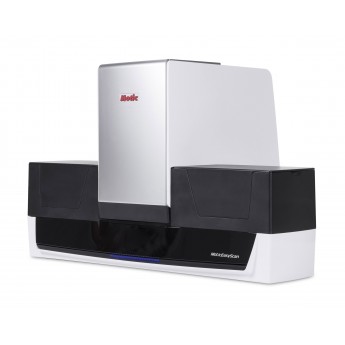
Motic slide scanner are designed to support efficient digital pathology workflows in modern laboratories. These systems enable automated multi-slide scanning within a single workflow, allowing laboratories to process large numbers of samples more efficiently. In addition, the scanners support both 1D and 2D barcode recognition, including Code 128, Data Matrix, and QR Code, enabling fast and accurate sample identification. This capability helps reduce the risk of manual data entry errors while improving sample traceability and laboratory data management.
In terms of imaging performance, Motic slide scanners provide high-resolution digital image acquisition suitable for detailed microscopic analysis. With capture resolutions of up to 12 megapixels, the system produces clear and detailed whole-slide images for documentation and remote analysis. The scanning resolution can reach 0.52 µm/pixel at 20X, 0.26 µm/pixel at 40X, and 0.13 µm/pixel at 80X, enabling precise visualization of microscopic structures. The integration of plan apochromatic objectives further ensures excellent optical performance and consistent image quality across different magnification levels.
Advanced Scanning Modes in Motic Slide Scanners
Motic slide scanner offer multiple scanning modes to support various analytical requirements. These include standard scanning with real-time autofocus and high precision autofocus for more advanced applications. The systems also support Extended Depth of Field (EDF) and Z-stack scanning, which enable layered imaging at multiple focal planes to produce more accurate representations of specimen structures. Slide scanner operation and data management are supported by dedicated software platforms such as DSAssistant and EasyScanner, allowing efficient control, scanning configuration, and digital image management.
A Strategic Investment for Future Laboratories
Digital slide scanning has become an important technology in modern laboratories, enabling microscopic specimens to be converted into high-resolution digital images that are easier to analyze, store, and share. With features such as automated slide handling, flexible scanning modes, precise autofocus systems, and high-quality optics, slide scanners help laboratories improve efficiency while maintaining accurate and reliable analysis.
To support laboratories in adopting this technology, PT. Sentral Lab Genetik, as the official distributor of Motic in Indonesia, provides advanced slide scanner systems designed for research, diagnostic, and educational applications. Along with the instruments, PT. Sentral Lab Genetik also offers technical consultation, installation, and comprehensive after-sales support to help laboratories successfully implement digital microscopy workflows.