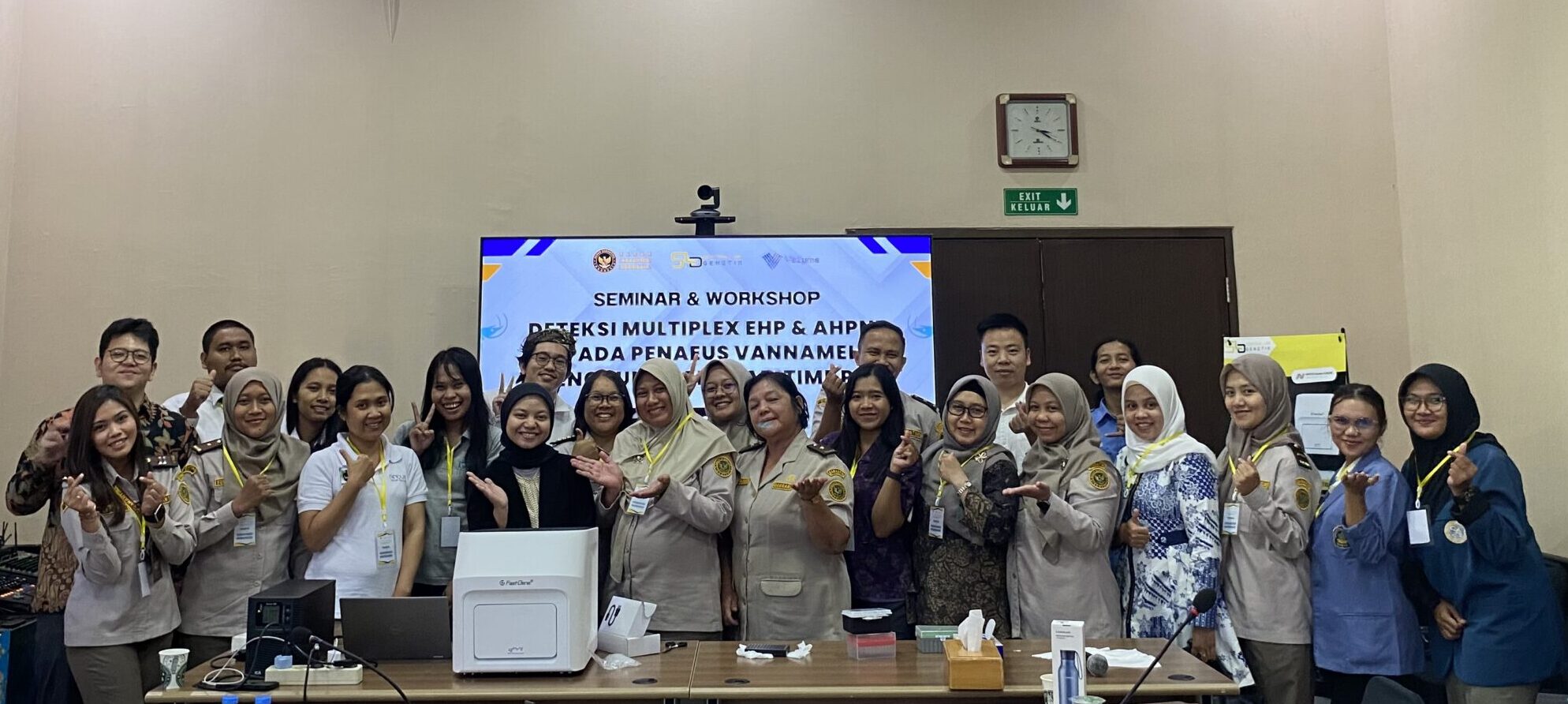
 On July 10, 2025, a seminar and workshop on the multiplex detection of Enterocytozoon hepatopenaei (EHP) and Acute Hepatopancreatic Necrosis Disease (AHPND) in Penaeus vannamei using real-time PCR was successfully held in Bali. The event gathered participants from BKHIT Bali, lecturers and laboratory technicians from various universities, as well as professionals from private companies, who joined both on-site and online.
The first session was presented by Mutia Balqis, S.Si, Application Manager at PT. Sentral Lab Genetik, who introduced the FastGene® qFYR Real-Time PCR System from Nippon Genetics Europe as an innovative solution for multiplex pathogen detection in shrimp. She explained how the qFYR system supports up to 4 + 1 detection channels, allowing simultaneous monitoring of multiple fluorescence signals in a single reaction. Equipped with a 12-column gradient function, this instrument enables efficient optimization of annealing temperatures, an essential step in developing multiplex PCR assays.
Mutia also highlighted the system’s rapid ramp rate of up to 6°C per second, ensuring faster run times and improved productivity in the lab. With excellent temperature uniformity and user-friendly analysis software, the qFYR real-time PCR system provides a powerful and reliable platform for multiplex pathogen detection in aquaculture research.
The second presentation was delivered by Zico Arman, M.Si, International Technical Support Specialist at PT. Vazyme Biotech Indonesia. He discussed the use of Vazyme Real-Time PCR Kits for the detection of EHP and AHPND in shrimp. Zico explained that Vazyme offers a wide range of detection kits, from singleplex to multiplex formats, which allow researchers to detect multiple pathogens in one reaction. By using multiplex assays, laboratories can significantly reduce testing time and reagent costs while maintaining accuracy and sensitivity. This approach provides an efficient and cost-effective solution for shrimp disease diagnostics, which is crucial for large-scale monitoring and prevention efforts.
Following the seminar, participants had the opportunity to directly engage in a hands-on workshop session, where they practiced the full workflow from sample preparation and reaction setup to real-time data acquisition and result interpretation. Through this practical experience, attendees were able to gain a deeper understanding of how multiplex detection is performed and how to analyze the data generated by real-time PCR instruments.
This seminar and workshop served as a valuable platform for sharing knowledge and practical expertise in molecular pathogen detection. It also strengthened collaboration among researchers, academic institutions, and the aquaculture industry. By introducing advanced tools such as the qFYR real-time PCR system and Vazyme detection kits, the event aimed to support more efficient, accurate, and scalable diagnostic approaches for shrimp health management in Indonesia.
We would also like to express our sincere gratitude to BKHIT Bali for giving us the opportunity to collaborate and conduct this meaningful workshop together.